Closed system
A boat is a closed environment. We don’t have the luxury of just placing the trash in a bin outside and having the city collect and dispose of it for us. We will always have to deal with our own refuse. With that in mind we will maintain a strict policy of: Reduce, repair, repurpose, reuse, recycle and review.
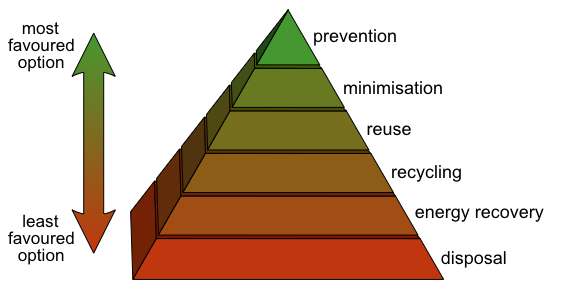
To be sustainable, waste management cannot be solved only with technical end-of-pipe solutions and an integrated approach is necessary. The waste management hierarchy indicates an order of preference for action to reduce and manage waste, and is usually presented diagrammatically in the form of a pyramid. The hierarchy captures the progression of a material or product through successive stages of waste management, and represents the latter part of the life-cycle for each product. The aim of the waste hierarchy is to extract the maximum practical benefits from products and to generate the minimum amount of waste. The proper application of the waste hierarchy can have several benefits. It can help prevent emissions of greenhouse gases, reduces pollutants, save energy, and conserves resources.
Reduce
Reducing is the most fundamental step. You don’t need to recycle or otherwise dispose something you never got. Bringing a reusable shopping bag to the market is a great way to cut down on how much you end up with. A big part of living a zero waste lifestyle is refusing what you do not need. Simply shop less and evaluate carefully every shopping decision to not purchase something that is not actually necessary. Also be careful with what guests leave behind and things that are given to us for free.
Be mindful of the life cycle of any item you purchase or acquire. Where did it come from and where will it end up? There are tons of options for borrowing and sharing to help reduce how much stuff you own. Choose to reduce as much as you can.
The sharing economy is bigger than ever. Access a wide variety of items and services only when you need them. Instead of giving gifts that someone won’t use or need, provide experiential gifts that create fun memories, not waste.
In case purchasing something is really necessary then the item should ideally have several qualities like being long-lasting and also easy to fix if it breaks. Second hand is better than new if quality isn't sacrificed.
Repair/Repurpose/Reuse
When things become worn or stop working, they often end up in the trash. By fixing and maintaining the items in our homes, we can keep them functioning longer. This way, you will have other options, like donation or resale, instead of adding them to the waste stream.
Never waste an opportunity to repurpose an item at the end of it’s useful life into fulfilling a new role. Extend the life-cycle of an item you may no longer need, by selling or donating it.
Recycle
If an item can’t be repaired, repurposed, or reused, it is time to recycle it. We have onboard the capacity to process most plastics and some kinds of rubber. Papers can often be reused. We also recycle waste oils.
Every other item that can be recycled should be stored for proper disposal at the next landing.
Review
Life cycle thinking and assessment can be used to support decision-making in the area of waste management and to identify the best environmental options. Life-cycle assessment provides an approach to ensure that the best outcome for the environment can be identified and put in place. It involves looking at all stages of a product’s life to find where improvements can be made to reduce environmental impacts and improve the use or reuse of resources. A key goal is to avoid actions that shift negative impacts from one stage to another. Life cycle thinking can be applied to all stages of the waste management hierarchy.
By refusing and repairing, you make it much easier to reduce items you don’t need and reuse items you already have. Always look for more ways to reduce and keep working to create less waste and make sure your items are recycled as much as possible. Do a zero waste challenge or waste audit. Are there items you could do without? Commit to your decision to reduce, reuse, recycle, repair, or refuse!