Language
I avoided using technical language more sophisticated than necessary, but I presume you understand at least the fundamental vocabulary of boat design and most nautical terms. If you find anything you don't understand, you will have an easy time find explanations for it on Google and here, here, and here.
Basic design decisions
We will stay on anchor most of the time when not cruising, instead of marinas. That keeps the costs down. It also means the boat has to be designed to spend long periods on anchor or mooring without the benefits of being connected to the dock. The production of drinking water, energy consumption and logistics are the most affected by this decision.
A boat designed for cold weather more than warm weather. We will probably spend more time in the cold than on the tropics. A pilot house is fundamental. Command position from inside the pilot house is the primary command location. Heating, insulation, and fuel consumption are very affected by this.
Capacity for eight people (captain, 1st mate, 6 passengers) while sailing. Plus a cat. In special circumstances like when visiting a special destination, may accommodate 10 people or more, but for staying onboard only during activities at anchor, not for sailing.
Study boat design
You can choose to just use the scantlings as they are. But I would recommend you study both scantlings rules and fundamentals of boat design so you would be familiar with all the reasoning behind them. Some of these documents were made free to download by their authors and, in those cases, I mirrored the file here for your convenience. Others you have to buy. Here are the links to the publications you can use to study:
-
 Preliminary Design of Boats and Ships
Intended for people who are not boat designers, this book describes how to bring a dream boat into being. Written by an experienced naval architect, it prepares intelligent amateurs create conceptual vessel designs ready for a naval architect's finishing touches. Included are the basic rationales and data needed to undertake a designing project, presented in a style that successfully bridges the gap between technical approach of naval architecture and the simplification of consumer magazine articles. This volume covers a variety of watercraft, so it can be equally useful if you're envisioning a cruising yacht or a sixty-foot fishing boat. -
 Elements Of Boat Strength For Builders Designers And Owners, by Dave Gerr
Acclaimed author and naval architect Dave Gerr created this unique system of easy-to-use scantling rules and rules-of-thumb for calculating the necessary dimensions, or scantlings, of hulls, decks, and other boat parts, whether built of fiberglass, wood, wood-epoxy composite, steel, or aluminum. In addition to the rules themselves, "The Elements of Boat Strength" offers their context: an in-depth, plain-English discussion of boatbuilding materials, methods, and practices that will guide you through all aspects of boat construction.
Now you can avoid wading through dense technical engineering manuals or tackling advanced mathematics. "The Elements of Boat Strength" has all the formulas, tables, illustrations, and charts you need to judge how heavy each piece of your boat should be in order to last and be safe. With this book, an inexpensive scientific calculator, and a pad of paper, you'll be able to design and specify all the components necessary to build a sound, long-lasting, rugged vessel.
P.S.: Here is an errata and some small updates to the book. -
 Gougeon Brothers on Boat Construction: Wood and West System Materials
This book is a compendium of techniques, best practices, and the reasoning behind them. But it is so much more than that; it is a springboard for your own ideas and inspiration to build. It does not read like a novel, nor is it a step-by-step how-to manual, but as a reference to which you can consult year after year, it stands above other books. It details what makes the WEST System work and why. Whether your next project is stitch-n-glue, strip plank, or cold molded, this book offers multiple examples and techniques. -
 The Sheathed Strip Alternative, by Daniel & Thomas MacNaughton
This article is a general description of the most advanced and efficient wood and epoxy boat building technique available today. It describes why it is so much superior to cold molded construction. A great many people assume that wood and epoxy boat building essentially means cold molding, but nothing could be further from the truth.
Though the basic concept of a hull shell composed of longitudinally laid square section strips sheathed inside and out transversely with either glass fiber and epoxy or carbon fiber and epoxy is quite simple, the reasons that make this structurally superior and extremely cost effective may not be immediately obvious.
This article will help you understand the method and evaluate whether you or your naval architect should be using it. Once you understand the method by reading this article you will probably want to immediately try working up scantlings for your favorite designs. -
 MacNaughton Scantlings Rule Book, by Thomas A. MacNaughton
This book is explores four different broad construction methods and a large number of variations. Each rule has been carefully engineered to represent the best of conservative modern practice in the particular methods chosen. These rules are used all over the world by naval architects, professional boat builders, amateur boat builders and yacht and commercial craft owners. All rules are intended to meet or exceed the same standards for strength and fatigue resistance. -
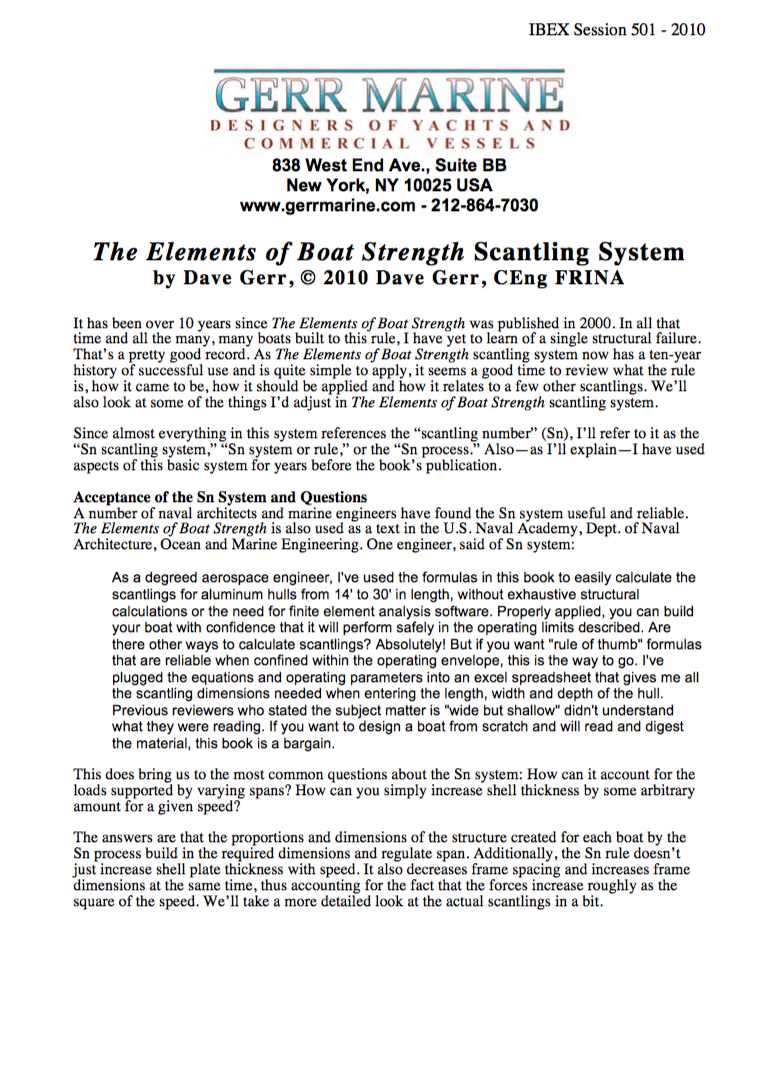 Paper presented at IBEX 2010, by Dave Gerr on the development,details and usefulness of the
Elements of Boat Strength scantling system.
Paper presented at IBEX 2010, by Dave Gerr on the development,details and usefulness of the
Elements of Boat Strength scantling system.
-
 Article on keel and rudder design, by David Vacanti.
-
 This series of articles appeared on BoatDesign.net during January to March 2010 and
covered the basic design ratios that are used in naval architecture and small craft design. This
PDF document is the entire series of “lectures,” if you will, in the order they appeared.
This series of articles appeared on BoatDesign.net during January to March 2010 and
covered the basic design ratios that are used in naval architecture and small craft design. This
PDF document is the entire series of “lectures,” if you will, in the order they appeared.
Regulations and compliance
- U.S. Coast Guard Federal and state government agencies have numerous statutes designed to protect life and property on the nation's waterways. Federal statutes authorize the U.S. Coast Guard to regulate the manufacture and safety standards of recreational boats and boating-related equipment. These include regulations for manufacturer certification, identification of boats, display of capacity information, safe loading and powering, flotation, electrical systems, fuel systems, ventilation, start-in-gear protection, navigation lights, backfire flame control, numbering undocumented vessels, carriage and use of personal flotation devices (PFDs), carriage and use of visual distress signals (VDS), carriage of fire extinguishing equipment, correction of especially hazardous conditions, and vessel identification system.
- National Fire Protection Assoc. Fire protection Standards for boats and yachts.
- American Boat and Yacht Council The best way to protect yourself is through liability insurance and to make sure you build to known accepted industry standards. You must build to the standards found in Federal regulations. That's the law. But, you have an option whether or not to build to ABYC standards or some other accepted standard such as ISO or ABS, or Lloyds to name a few. In the USA most courts use ABYC as the de facto standard. That means that most manufacturers use ABYC standards and accept them as the benchmark of boat construction.
- National Marine Manufacturers Association The NMMA has developed certification programs to help manufacturers comply with established standards and safety regulations, and to help inform the public of such compliance when purchasing equipment. The NMMA program certifies that the design meets the standards in the NMMA Certification Handbook. The manufacturer has the responsibility of assuring that production units are manufactured in compliance with the certified design.
Software
-
 Curio is an intuitive, freeform notebook environment with all the integrated tools you
need to take notes, brainstorm ideas, collect research, and organize your tasks and documents.
A single, incredibly powerful application where you can be more productive and focus on getting
things done.
Curio is an intuitive, freeform notebook environment with all the integrated tools you
need to take notes, brainstorm ideas, collect research, and organize your tasks and documents.
A single, incredibly powerful application where you can be more productive and focus on getting
things done.
-
 Numbers iis a spreadsheet application developed by Apple Inc. as part of the iWork
productivity suite alongside Keynote and Pages.
Numbers iis a spreadsheet application developed by Apple Inc. as part of the iWork
productivity suite alongside Keynote and Pages.
-
 DELFTship marine software is used by design offices and on ships all over the world. It
specializes in the development of high-end marine software, using state of the art technologies
for which the foundation was laid at the Delft University of Technology. It combines an accurate
and fully 3D model of the vessel, cutting edge technologies and a highly optimized graphical
user interfaces into software that is easy to operate and very accurate.
DELFTship marine software is used by design offices and on ships all over the world. It
specializes in the development of high-end marine software, using state of the art technologies
for which the foundation was laid at the Delft University of Technology. It combines an accurate
and fully 3D model of the vessel, cutting edge technologies and a highly optimized graphical
user interfaces into software that is easy to operate and very accurate.
-
 ArchimedesMB is a low cost, benchmarked, software utility for generating hydrostatics and
cross curves for arbitrary floating bodies. It employs a robust engine for calculating the
submerged volume of complex cross sections and as such can handle multiple waterline crossings,
hollow sections, coincident sections and sections with zero area (for defining hull/appendage
limits of length). ArchimedesMB is free for non-commercial use.
ArchimedesMB is a low cost, benchmarked, software utility for generating hydrostatics and
cross curves for arbitrary floating bodies. It employs a robust engine for calculating the
submerged volume of complex cross sections and as such can handle multiple waterline crossings,
hollow sections, coincident sections and sections with zero area (for defining hull/appendage
limits of length). ArchimedesMB is free for non-commercial use.